Insights💡
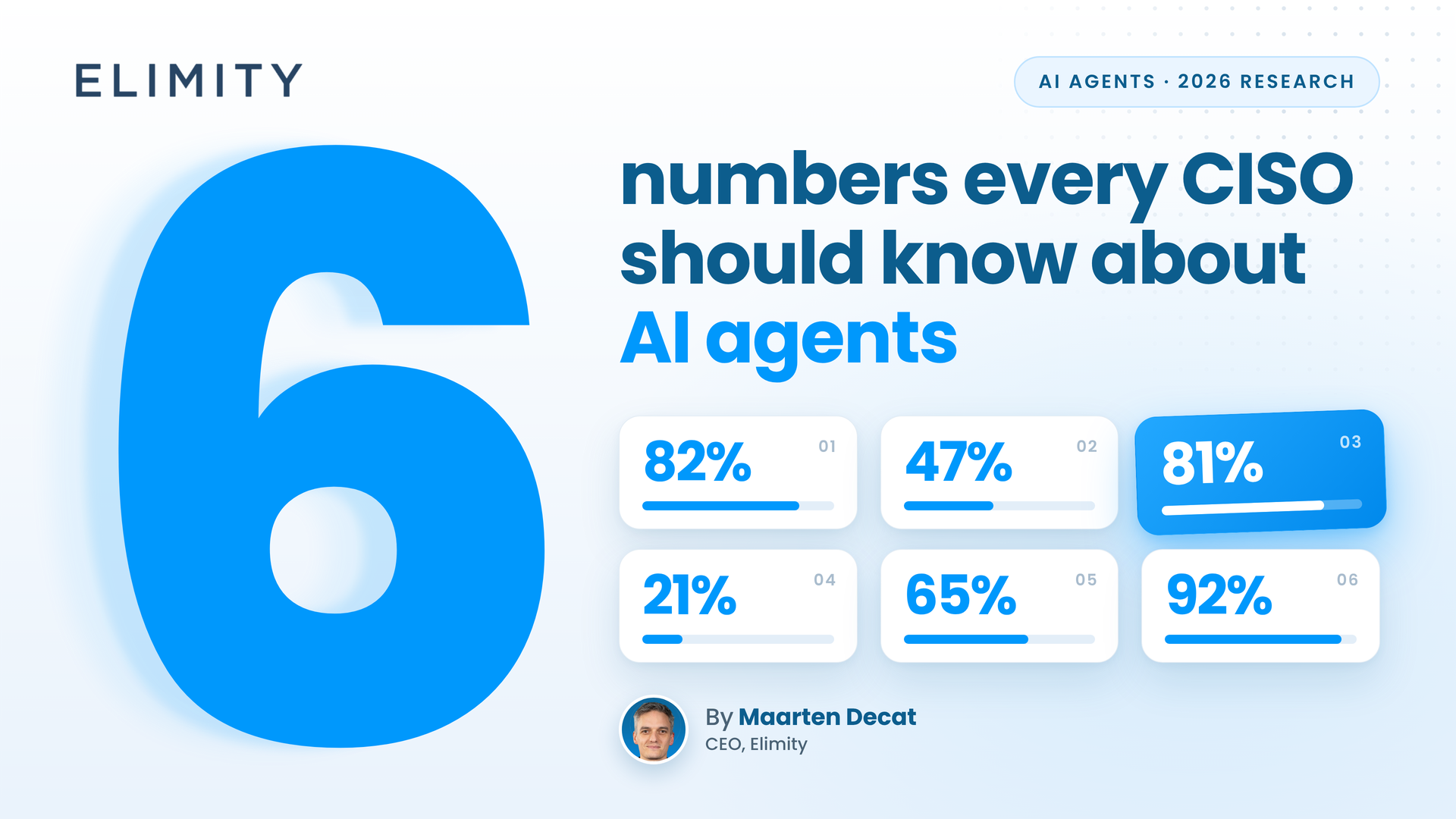
81% of CISOs are concerned about excessive AI access. It is one of the main findings of Okta's 2026 survey of 306 security executives, and of the numbers below it is the one you can act on first.
AI agents now act with real permissions inside company systems. Three studies published this year asked how well organisations can answer one question about them: who, and which agents, can access what?
Here are six numbers from that research, and what each one means for your identity programme.
1. 82% discovered AI agents they did not know about
The Cloud Security Alliance surveyed 418 IT and security professionals. 82% had discovered previously unknown AI agents in the past year. For 41%, it happened more than once.
The agents turned up in ordinary places: internal automation and scripts (51%), LLM platforms such as custom tools, assistants and plugins (47%), and SaaS tools with built-in automation (40%).
One more figure from the same survey explains why this goes unnoticed: 68% said they were highly confident in their visibility into AI agents.
2. 47% can identify every agent
Okta asked CISOs directly. Fewer than half (47%) are confident they can identify all AI agents in their environment.
So more than half can't. And you can't govern an agent you can't see.
3. 81% are concerned about excessive AI access
An agent can read a directory, change files or call another system, like any other identity. 81% of CISOs are concerned about excessive AI access.
They have reason to be. In 21% of organisations, AI agent access is still governed with shared credentials or broad-permission service accounts. That is access that was never scoped to the agent itself.
4. 21% have a formal process to decommission agents
Only 21% of organisations have a formal process to decommission AI agents. Just 19% are highly confident that they fully retire their agents.
Without that process, an agent can outlive its project and its owner, and keep its access. It is the orphaned service account again, at machine speed.
5. 65% had an AI agent-related incident
65% of organisations reported at least one AI agent-related incident in the past year. Of those, 61% cited data exposure, 43% operational disruption and 35% financial cost.
6. 92% of AI-related breaches came with missing access controls
IBM's Cost of a Data Breach Report 2026 studied 602 organisations that suffered a breach. Roughly one in five reported an AI-related breach: an attack on AI models or applications. Of those, 92% lacked proper AI access controls.
The same report found that fewer than half of organisations actively secure non-human identities, the group AI agents belong to.
What the six numbers have in common
None of them describes a new kind of problem. First came your workforce, then your service accounts and API keys. AI agents are next. It is the same identity challenge at a bigger scale and a faster pace, and it starts with visibility.
Read together, the research comes down to three questions you should be able to answer for every agent:
- Which agents do we have, and where were they built?
- Who is accountable for each one?
- What can it reach, and when was that last reviewed?
Where to start
- Connect the platforms where your agents live. Start with the ones you already use, such as Microsoft Entra Agent ID, Amazon Bedrock and Google Vertex AI, and bring every agent into one list.
- Link each agent to a person. Every identity, human or not, needs someone who answers for it. When that person changes role or leaves, the agent should not be left behind.
- Review what each agent can reach. Add agents to the access reviews you already run for employees and service accounts. Look first for excessive access and for legacy agents that still hold permissions.
How Elimity helps
Elimity is the Identity Visibility and Intelligence Platform that shows who has access to what across your employees, service accounts and API keys. Now also for your AI agents: see every agent, who owns it and what it can reach.
Elimity for AI Agents connects to Microsoft Entra Agent ID, Amazon Bedrock and Google Vertex AI, with more platforms on the way. Your agents appear in the same view as every other identity, linked to the people who answer for them, and they join the access reviews you already run.
Go deeper
On Thursday 19 November at 16:00 CET, Christian Bartels (CRO Elimity, former CISO) and Isabelle Pfahler (Solution Expert, PlanB.) share five practical tips on how organisations can handle AI Agents. Save your seat, or watch it on demand afterwards.
See your own AI agents, who owns them and what they can reach
Related article: You can't govern what you can't see
Sources
- Cloud Security Alliance, Autonomous but Not Controlled: AI Agent Incidents Now Common in Enterprises, commissioned by Token Security, April 2026. 418 IT and security professionals.
- Okta, Global CISO Insights 2026, July 2026. 306 CISOs, heads of cybersecurity and other security executives.
- IBM, Cost of a Data Breach Report 2026, with the Ponemon Institute, July 2026. 602 organisations.